Best International Cargo & Freight Logistics Services in Brazil
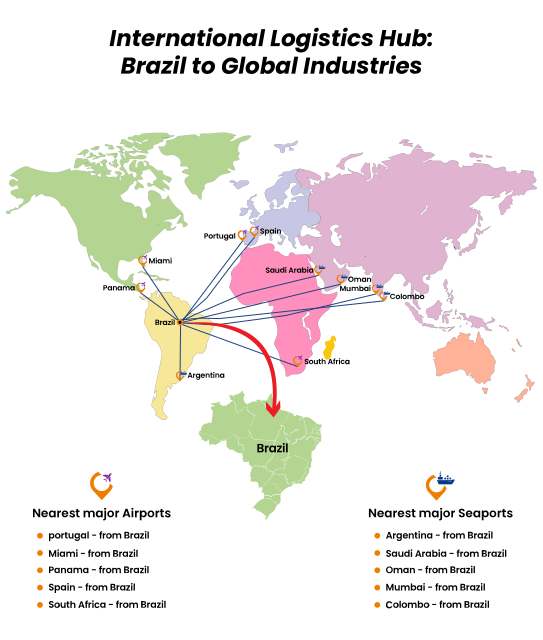
Air And Sea Freight From Brazil to Worldwide Shipping
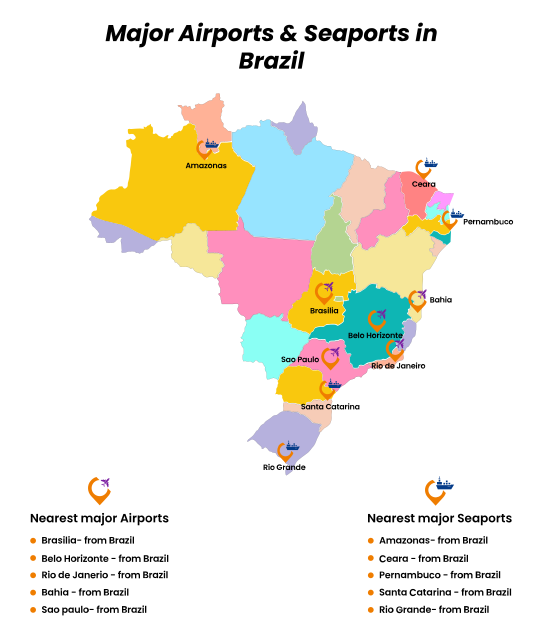
Major Airports and Seaports Across Brazil

Brazil is a continental-scale market with deep commodity and manufacturing capacity, connected to global trade through major blue-water ports like Santos and Paranaguá and supported by strong inland corridors that reach farms, mines, and industrial centers. Trade activity remains robust. In 2024, Brazil had one of its highest trade surpluses, approximately USD 74.5 billion, exporting approximately USD 337 billion of goods and importing approximately USD 262.5 billion. This performance indicates the strong demand in the global market of crude oil, soybean, iron ore, meats, and sugar that is matched by the consistent importation of Brazil that needs fuels, machinery, vehicles, fertilizer, and other essential inputs.

The partner network is wide, with China, the United States, and Argentina among Brazil’s leading trade destinations and sources, supported by thousands of active exporters that extend the country’s global reach. Bills of lading data highlight mineral fuels, oilseeds, and ores as dominant cargo groups and confirm strong two-way volumes with major economies, providing logistics planners dependable flow on both outbound and inbound lanes. Sarvam Logistics supports these movements through tailored routings, optimized vessel and flight connections, and expert customs guidance, all designed to align with Brazil’s key trade corridors and seasonal demand cycles.
Features of Reliable Freight & Logistics Services in Brazil

Strategic Geographic Location

  • Brazil’s coastline links South America’s largest consumer base to North America, Europe, and Asia, while river systems and north–south trunk corridors connect farm belts and mines to blue-water ports. Waterborne cargo reached a record 1.32 billion tonnes in 2024, highlighting sustained seaborne capacity.

  • The 2024 merchandise surplus was about 74.6 billion dollars on 337 billion in exports and 262.5 billion in imports, reinforcing bidirectional freight demand for commodities, fuels, capital goods, and intermediate inputs.

  • Shipment intelligence confirms leading export groups in crude oil, soy, iron ore, meats, and sugar, with two-way trade across China, the United States, and regional partners. Volza and WITS profiles align on these categories.

Major Ports & Airports

  • Seaports : Santos (BRSSZ) is Brazil’s main hub for containers and general cargo, having set a new monthly record of about 460,800 TEUs in January 2025. Paranaguá is the country’s second-largest container gateway, handling around 1.56 million TEUs in 2024, with strong demand from temperature-controlled and agribusiness sectors. In the Northeast, Suape and Pecém are leading the development of industrial and energy corridors, continuing to expand their role in both regional and international trade.

  • Air cargo : Guarulhos (GRU) is the major international cargo gateway, where the total cargo moved was close to 338 thousand tonnes in 2024; Viracopos (VCP) is the main airport for the express and high-tech sector; Galeão (GIG) has augmented its capacity for long-haul freighters and pharma to achieve about 59.7 thousand tonnes in 2024.

Advanced Infrastructure

  • Brazil’s Single Window, Portal Único Siscomex, and the new DUIMP import process reduce clearance times. Government estimates indicate export release fell from 13 to about 4.8 days and import times from 17 to about 9 days. Full migration aims to achieve clearance times of approximately 5 days, delivering substantial annual cost savings.

  • The Authorized Economic Operator program (OEA) provides priority treatment and measurable time reductions across modes; Receita Federal reports ongoing expansion and faster export and import processing for certified operators.

  • Strategic rail and road corridors continue to scale capacity. Federal programs advance the Oeste–Leste Railway (FIOL) toward integration with the North–South line, improving agribusiness and mining export routes to Bahia’s coast. Cabotage and long-haul coastal services add additional domestic capacity.

Diverse Economic Sectors

  • Outbound flows are basically raw oil, soy complexes, iron ore, pulp, meats, and sugar, while inbound volumes are fuels, machinery, auto parts, fertilizers, and pharmaceuticals. WITS and Reuters reveal a robust two-way trade that is not significantly affected by commodity cycles, thus, both headhaul and backhaul in ocean and air are being maintained.

  • Air freight is instrumental in the growth of high-value industries such as pharma, aerospace, and electronics. Carrier data show GRU and VCP as the main international hubs, with GIG increasing the share of U.S. and Europe lanes and facilitating release times.

Brazil’s logistics backbone couples record seaborne throughput with expanding Single Window, trusted trader programs, and deep port-airport corridors. The result is dependable capacity for bulk and containerized cargo, steady uplift for time‑sensitive freight, and multiple routing options to manage seasonality and shocks.

Brazil’s Freight Solutions & Worldwide Shipping Services

Sea Freight

Trusted International Ocean Freight Forwarding Service in Brazil for Safe Global Shipping

Supported by major gateways such as Santos, Paranaguá, Itajaí and Itapoá, Rio Grande, Suape, and Pecém, Brazil’s maritime system handles substantial volumes of containers, bulk, and breakbulk cargo linked to agribusiness, energy, mining, and manufacturing. These ports handle reefer meats and fruits, pulp and paper, sugar, coffee, crude and fuels, project cargo for infrastructure, and roll-on/roll-off units for autos and equipment. Services include full container load, consolidation, breakbulk, cross-trade routing, and domestic cabotage connecting coastal markets with inland production zones. With steady mainline calls to North America, Europe, and Asia, Sarvam Logistics coordinates bookings, verifies documentation and licenses, and manages port operations to secure space, protect cutoffs, and maintain predictable ocean transit.

Read More

Air Freight

Reliable International Air Freight Cargo Services in Brazil for Fast and Secure Global Deliveries

Centred on the airports of Rio de Janeiro-Galeao(GIG), Viracopos(VCP) and anchored by the airports of Sao Paulo-Guarulhos(GRU), Brazilian air cargo network is highly reliable to supply pharmaceuticals, electronics, aerospace and high value spares with long haul connectivity. The types of services that are offered are priority express, temperature controlled shipping, express flights to transport time sensitive or oversized cargo, and sea air combinations that are a combination of speed and cost efficiency. Facilities provide high security storage and bonded handling with certified cold chain solutions with round the clock temperature control and real time milestone tracking. Carriers and handlers maintain IATA aligned processes for special cargo categories. To meet the strict lead times of Brazil’s trade heavy sectors, Sarvam Logistics provides specialized handling, agile scheduling, and reliable on time delivery across the main cargo airports.

Read More

Customs Clearance

Trusted Customs Clearance Agent and Broker in Brazil for Hassle-Free Import and Export Services

Brazil’s customs environment demands precise documentation and careful planning under Portal Único Siscomex, with import licenses, health and technical permits, and thorough tariff and origin controls. Experienced brokers manage tariff classification under the Mercosur nomenclature, calculate duties and taxes, handle drawback and temporary admission programs, and operate bonded warehousing and in transit movements. Trusted trader certification under the Authorized Economic Operator program accelerates procedures, while the new import declaration model(DUIMP) streamlines steps for compliant shippers. Documentation for high value, hazardous, or time sensitive cargo follows Receita Federal and sector agency criteria to avoid holds. Sarvam Logistics ensures full regulatory compliance, transparent status updates, and coordinated inspections. Through the above measures, the clearance time is reduced and the critical delivery window is protected.

Read More

Other Programs

We offer multimodal transport services in Brazil, including air, sea, and land for efficient logistics.

Brazil’s multimodal logistics network connects export corridors from farming and mining regions to blue water ports via road and rail, supported by a growing network of inland terminals that handle containers, reefers, and project cargo. Distribution hubs around São Paulo and Campinas support manufacturing and e-commerce operations with intelligent warehousing, value-added services, and inventory visibility, enabling just-in-time replenishment. Coastal services provide additional capacity for domestic repositioning and seasonal surges, while specialized lifting and route surveys enable safe movement of oversize equipment for energy and infrastructure projects. Our Services include nationwide distribution, project logistics, last mile delivery in major metros, and secure storage with kitting, labeling, and returns management. These integrated capabilities deliver stable throughput and risk control across Brazil’s peak seasons.

Read More

Opportunities & Scope of Brazil Logistics Industry

  • Large domestic market with strong agriculture and industrial sectors.

  • Rise of e-commerce and agribusiness exports driving logistics demand.

  • Investments in road infrastructure, ports, cold chain, and automation.

  • Expanding intermodal transport and tech-driven logistics solutions.

  • Government policies support infrastructure, digital customs, and sustainable logistics.

  • Major trade partners: China, the US, Argentina, Germany,the Netherlands.

Key Trade Products Exported & Imported by Brazil

Region/City Industry/Sector Key Activities/Products Major Trade Focus Primary Freight Mode
Brazil Agribusiness Soybeans, corn, sugar, coffee, meat and pulp products Exports: soy complex, meats, sugar to China, US, Europe Sea Freight
Mining & Minerals Iron ore, bauxite, manganese and gold concentrates Exports: iron ore, minerals for steel and aluminum sectors Sea Freight
Energy & Fuels Crude oil, refined petroleum, biofuels and natural gas Exports: crude oil; Imports: fuels and equipment for energy production Sea Freight
Machinery & Equipment Industrial machines, turbines, vehicles, auto parts and robotics Imports: machinery, vehicles; Exports: manufactured goods to regional markets Sea Freight
Pharmaceuticals & Specialty Foods Medicaments, vaccines, fruits and juices. Exports & imports: time-sensitive pharma and foods to US, Europe Air Freight

Why Choose Sarvam Logistics for Brazil?

Industry-Focused Logistics Solutions in Brazil

Industry Expertise

Having demonstrated expertise in Brazil's agricultural, mining, and energy industries, we solve difficult logistics problems to enable dependable exports and imports with operational accuracy.

Integrated Supply Chain Services Across Brazil

Total Supply Chain Solutions

We develop robust supply chains that integrate Santos Port, Guarulhos Airport, and key inland corridors, ensuring an uninterrupted flow of goods for Brazil’s high-volume commodity and manufacturing sectors.

Expert Customs Clearance & Compliance Support

Customs & Compliance Mastery

Our experts navigate Portal Único Siscomex and OEA programs expertly, streamlining DUIMP processes to achieve faster clearances and total compliance for Brazilian shipments.

Eco-Focused Transport & Warehousing in Brazil

Sustainable Logistics Commitment

We adopt biofuel vessels and sustainable warehousing to reduce emissions, meeting Brazil’s green initiatives while handling efficient transport of soy and iron ore.

Secure Best Freight, Customs & Delivery Services in Brazil

Ensure seamless cargo movement across Brazil’s main ports and airports with precise scheduling, documentation accuracy, and dependable carrier coordination. Our team supports you from booking to final delivery, reducing delays, risks, and total landed cost.

FAQs on Shipping Customs & Cargo Services in Brazil

Which Brazilian port is best for my shipment?
Santos offers large-scale handling for containers and general cargo. Paranaguá is strong in agribusiness and reefers. Itapoá and Itajaí provide agile container operations, while Suape and Pecém serve industrial corridors.
What are typical ocean transit times to and from Brazil?
Depending on the service, delivery to Asia is normally between 30 and 45 days; to the U.S. West Coast, 25 to 35 days; to the U.S. East and the Gulf, 10 to 14 days; to Europe, 12 to 17 days.
How do Portal Único and DUIMP improve clearance?
Unified data entry, advanced risk analysis, and integrated inspections significantly shorten processing times. Compliant shippers often benefit from faster cargo release, fewer touchpoints, and greater visibility into status.
Do I need import licenses or agency permits?
Many health, food, medical, telecom, and chemical goods require licenses from ANVISA, MAPA, or Anatel. Early checks avoid holds and storage costs.
What taxes influence landed cost in Brazil?
Imports may be subject to II (Import Duty), IPI (Excise Tax), PIS, COFINS, and state-level ICMS. We model cost scenarios, plan trade regimes such as drawback or temporary admission, and align Incoterms with your budget targets.
Can you manage cold chain and time-sensitive air freight?
Yes. GRU and VCP offer GDP-compliant facilities, active containers, prioritized handling, and milestone tracking for pharmaceuticals and critical spares.
How do you mitigate congestion, weather, and inspection variability?
Capacity protection, alternate routings, bonded storage, advanced licensing, and continuous communication stabilize schedules and reduce exposure to demurrage, detention, and peak season delays.

Interested with this service. Want to work with us for your Next Project?

dummy

Get Quote

Whats app

Call